

They're pulling away. Here's how to bring them back.
Not with big apologies or one dramatic move. The Repair shows you the exact 5-step process to stop the hidden leak, rebuild trust through consistent, research-backed actions, and become the person they choose again.
Stop the bleed. Heal it with integrity.
Why this is different
Most advice tells you to apologize. This fixes the leak you couldn't see.
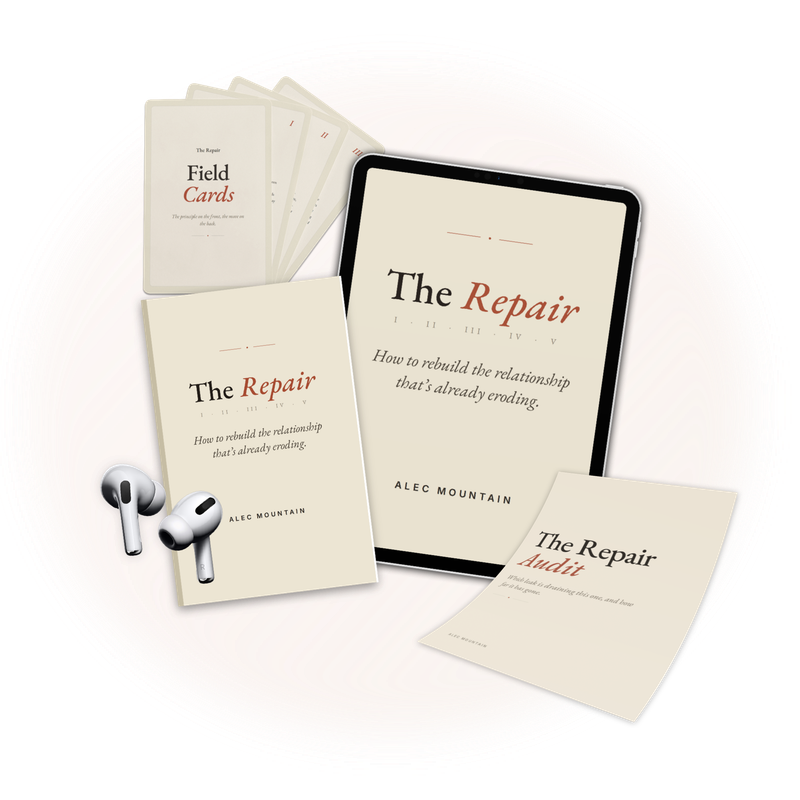
Make the grand gesture. Write the heartfelt letter. Buy the thoughtful gift. You've probably tried one of these, and it didn't last. No single gesture can undo a hundred small moments that taught them to expect less of you.
The Repair works differently. First you stop the thing that's pushing them away. Then you win their trust back step-by-step, through small actions repeated until they can feel the difference. It isn't a speech you give. It's a plan you follow.
Effective for couples, but built to work across a whole series of relationships: close friends, family members, and colleagues. One protocol, for every relationship worth saving.
If any of this is painfully familiar
You can feel it slipping. You just can't name it.
- They used to reach out just to talk. Now they only answer when you start it.
- They used to lean in. Now they keep it polite, careful, a little distant.
- You have tried the big apology, the gift or dinner, the heartfelt message, and the temperature never actually shifts.
- You can't necessarily point to an intense fight or a betrayal. Nothing dramatic happened. It just got colder over time.
- Some part of you suspects you caused it, one small slip at a time, and you don't know how to undo it.
Who this isn't for
If any of this is also true, this isn't for you.
The Repair asks one thing of you before anything else: that you're willing to own your part and put in the effort. If any of these is true, it won't help you, and I'd rather say so now.
- You want a script to win them back as a tactic. This isn't persuasion. It asks you to reverse the damage, which is slower and harder than any line.
- You want to be told it wasn't really your fault. This leads with the opposite: you caused this with your own behavior, and here is how to honestly repair it.
- You expect it fixed overnight. Real repair can often be slow, not one grand gesture, and it takes a series of small, consistent steps before the other person starts to come around. If you can't be patient with that, this will only frustrate you.
What's inside
Five steps, in order.
They go in order, and the order matters. Skip a step and the next one has nothing to stand on.
Name the Leak
You cannot repair what you cannot name.
Stop guessing at what went wrong. Pin down the one thing you actually did, again and again, that taught them to expect less of you. That is the thing you fix.
Stop the Bleed
Good things don't count while the bad one continues.
Almost everyone rushes past this to the good part. It's the single most common reason repair quietly fails.
Reset the Expectation
Say it once, keep it small, then go quiet.
Almost everyone overdoes it here, turning it into a long apology or a big promise. Do that and you reset nothing.
Rebuild by Accumulation
Win them back the way you lost them.
What actually rebuilds trust is so small and unglamorous that almost no one reaches for it, which is exactly why it works.
Outlast the Discount
Their first reaction is not their final answer.
At first they won't believe it, and most people quit right there. This step shows you why to keep going, because that doubt is exactly the moment before it works.
How it works
Read it tonight. Start tomorrow.
i.
Read it in one sitting.
Every step is built the same way: the principle, the research behind it, the exact move, and the moment it backfires. Short on purpose, so you finish the whole thing tonight.
ii.
Make it yours.
It isn't generic advice. The guide walks you to the one behavior driving your distance and the specific plan for your situation, so you finish with your own next move, not just the theory of one.
iii.
Trust the process.
The guide maps what to expect as the weeks pass, including the stretch that feels like failure and isn't, so you hold on through the exact moment most people give up.
What changes
Not a performance they'll see through. A change they can finally feel.
You won't announce any of this. You'll simply stop doing the thing that taught them to expect less, and quietly do the opposite, again and again. And slowly, they start to come back.
They stop bracing. They reach out first again. They call instead of just replying. And the person you had to become to win them back is the person you stay, which quietly changes every other relationship in your life too.
Built on evidence
Not opinions. Research.
Each step rests on an established finding about how trust breaks and how it comes back, not opinion. Named work, checkable sources.
Step I · Name the Leak
Trust doesn't break in general. It breaks along a specific line, and the repair for one kind does almost nothing for the other. Aim at the wrong one and you only prove you still don't understand what you did.
Kim, Ferrin, Cooper & Dirks
Step II · Stop the Bleed
A single fresh instance of the old behavior doesn't just cancel a good deed. It outweighs several. You are not playing an even game.
Baumeister, Bratslavsky, Finkenauer & Vohs
Step II · Stop the Bleed
Stable relationships run about five positive interactions for every negative one during conflict. Breaking even leaves you behind.
John Gottman & Robert Levenson
Step III · Reset the Expectation
A bare apology does surprisingly little. A credible promise speeds recovery, but a promise you break does more damage than no promise at all.
Schweitzer, Hershey & Bradlow
Step IV · Rebuild by Accumulation
Trust harmed by behavior is fully restored by a consistent series of trustworthy actions over time. Not one grand act. A series.
Schweitzer, Hershey & Bradlow
Step IV · Rebuild by Accumulation
New patterns take longer and vary more than people expect. The gains come fastest at the start, and a single missed day does not erase the progress.
Lally and colleagues
Step V · Outlast the Discount
Once a relationship tips negative, the other person runs even your kindnesses through a negative filter and stops registering the good. They aren't being unfair. A brain that's reached a verdict screens out the evidence against it.
Weiss & Gottman
A look inside
Here's how one step actually works.
A real taste, not the whole thing. One of the five steps, in the shape they all take: the principle, the move, and the way it quietly backfires.
Stop the Bleed
Good things don't count while the bad one continues.
When you've hurt someone, every instinct says to make up for it: be warmer, more generous, more present. It feels right, and it's the one move that can't work. You're trying to fill the account while it's still draining.
Here's why, and it's a little brutal: bad outweighs good. One slip of the old behavior doesn't cancel a kind act, it cancels several. Stable relationships run about five good moments for every bad one, so until the slips stop, every good thing you add gets swallowed by the next one.
The move
The move runs against the instinct: stop the one behavior completely, before you add a single good thing. If you were unreliable, you're simply not late again, starting now. No announcement. Nobody praises you for it, and you do it anyway. Everything else is built on this.
Where it backfires
The trap is telling them you've stopped. "Notice I haven't done that all week?" That turns it into a performance and asks them to reward you, which reopens the very thing you just closed. This part is silent. It's for them, not for your credit.
That's one step, up close. The other four work the same way. You can read all five tonight.
What you get
A protocol you can run tonight.
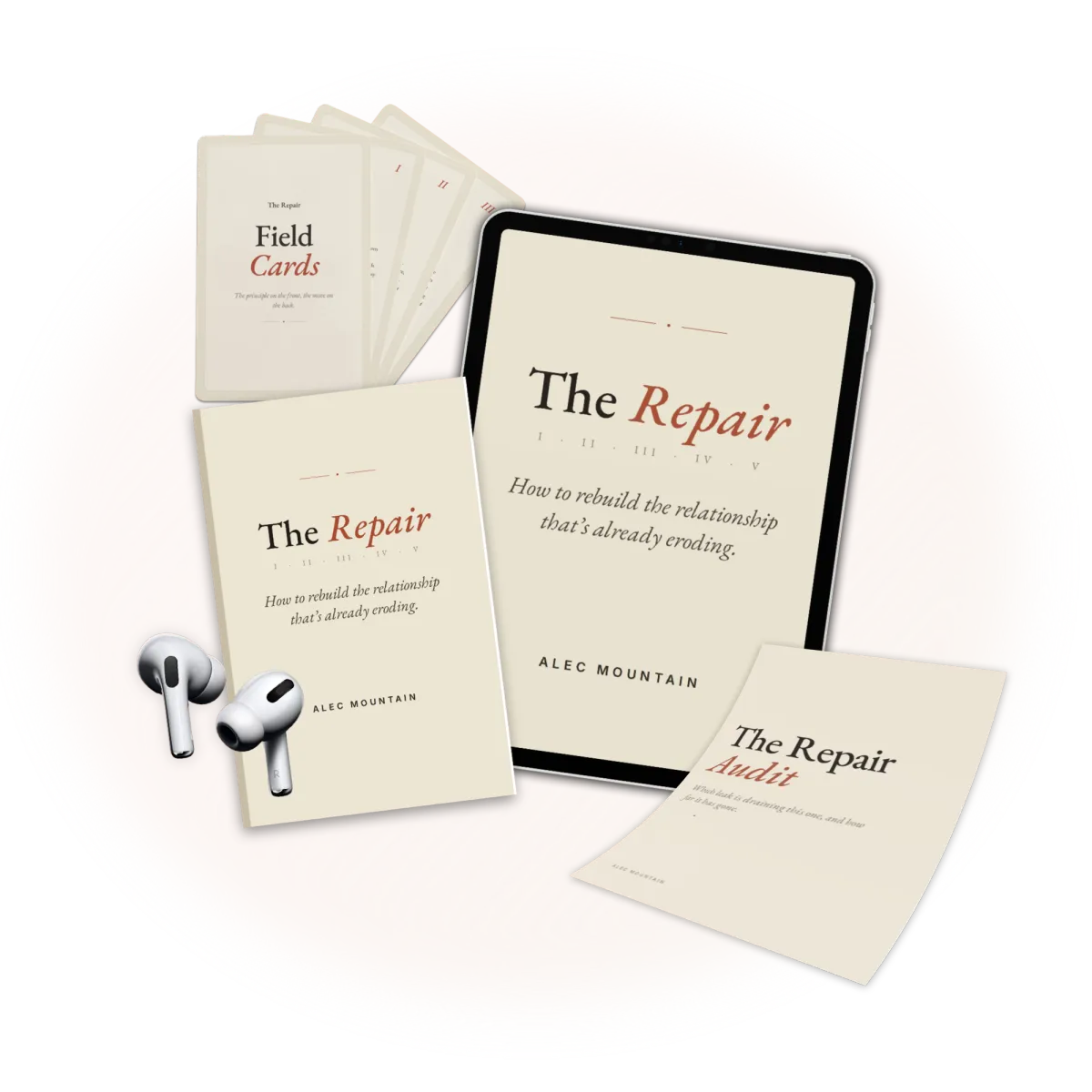
Everything delivered instantly, on your phone in under a minute. The protocol is short by design: this is a tool you run, not a book you study. Read it tonight, start tomorrow.
Instant · Included
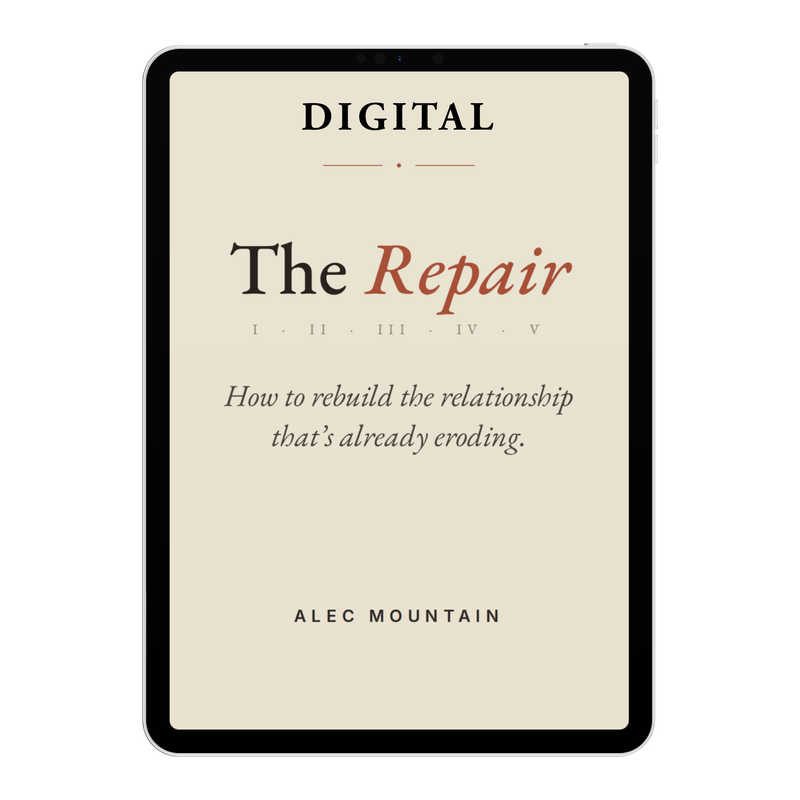
The Repair: The Full Protocol
All five steps in sequence, each with the research behind it, the exact move, the real example, and the precise way it backfires. Plus the honest line on when not to use it at all. A fast read with a lasting method.
Included
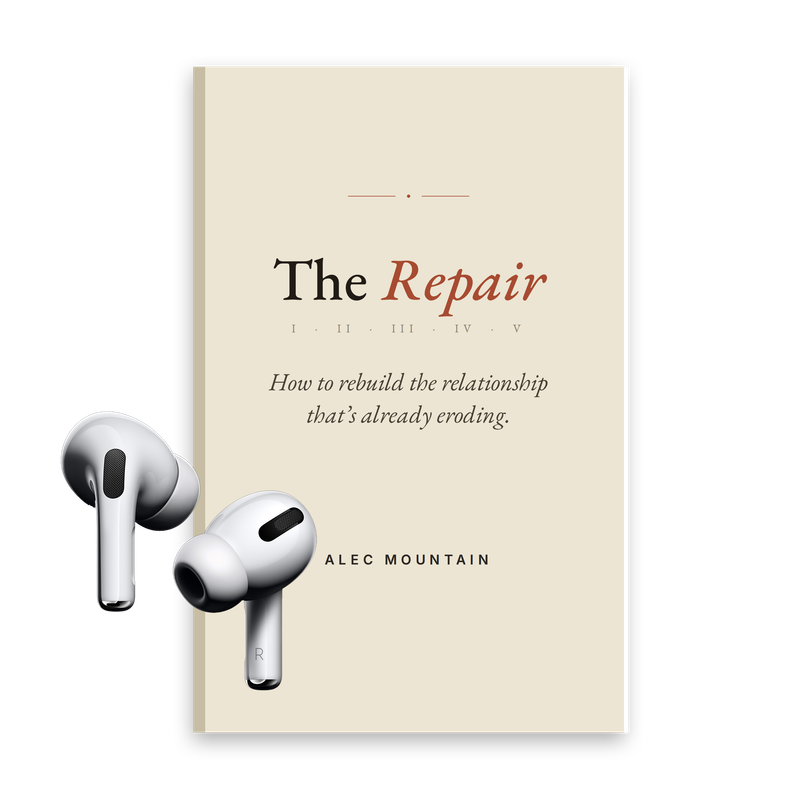
The Audio Edition
Run the whole protocol on a walk, a drive, or at the gym, then replay any single step in minutes on the day you need it. The fastest way to keep it in your head instead of on a shelf.

Bonus · Included
The Five Field Cards
Pull up any step in seconds before the moment that matters: the hard conversation, the apology, the night you decide to start. The principle on the front, the move on the back. The protocol, ready exactly when you need it.
Bonus · Included
The Repair Audit
Find out which leak is draining your relationship and which step to start with, in under five minutes. Most people spend months working on the wrong thing. The audit names the real one and points you to where the repair actually begins, so you stop guessing and start in the right place.
You have already been paying for the cost of not fixing it, in a relationship that's quietly getting colder. This costs $29, once.
$29

About the author
I wrote this because no one ever showed me how to bring people back.
I'm Alec Mountain. I wrote a top-selling book called Quietly Rejected, about the small behaviors that quietly push people away, at work, with friends, in the relationships you thought were solid. The Repair is what you do once you realize your behaviors have cost you someone, and you want them back.
Almost everyone reaches for the grand gesture first: the big apology, the promise to change, the one move meant to fix it all at once. It doesn't work, because that isn't how trust comes back. You earn it back through small, repeated proof, until they stop bracing and start trusting you again. The Repair is the protocol I wish I'd had, with every step built on what the research actually shows, not on hope or instinct.
— Alec
FAQ
Commonly asked questions.
What if they already feel distant or checked out?
That is who it is built for. The Repair assumes they have already cooled, and it plans for the hardest part: the stretch where your early effort gets waved off because they don't believe it yet. Their first reaction is not their verdict. The protocol shows you how to hold steady through exactly that window, which is where most people give up one move too soon.
What if I'm not even sure what I did?
Most people aren't, because the damage was a hundred small moments you have mostly forgotten, not one obvious event. You don't need to walk in knowing. The first step exists for this: it takes you from the vague sense that they are pulling away to the one specific thing you did, again and again, that taught them to expect less. You find it from scratch, with the guide.
Is this only for romantic relationships?
No. Most people come to it for a partner, but the same erosion happens in a friendship, with family, even at work, and the five steps work the same way. The pattern that broke the trust, a hundred small letdowns, doesn't change with the type of relationship. Neither does the repair.
How long does the repair actually take?
Longer than you want, and the guide is honest about that. The research on new habits runs from a few weeks to the better part of a year, depending on the person and the difficulty. The gains come fastest at the start, and the guide tells you exactly what to expect so you don't quit right before it works.
What's the refund policy if it isn't what I expected?
Thirty days, full refund, keep everything. Email me, no explanation required. If it isn't worth more than the price, I would rather refund you than have you feel like you wasted the money.
A note on the guarantee
Read it. If it's not worth more than $29, I'll refund you.
$29 isn't nothing. You worked for it. So here is the deal: get instant access, read the five steps tonight, and start repairing it tomorrow.
If it isn't worth more than what you paid, email me within thirty days and I'll refund your $29 and let you keep the whole thing. No forms. No hoops. No questions.
— Alec